Updates
The system is developed with changes relevant to foreign worker legalization workflows in mind.
Amarant helps staffing agencies, HR departments, employers, and legalization specialists manage foreign national cases in one place. Client and employee cards, documents, residence and work deadlines, tasks, reminders, and reports — everything needed for daily work in one place.
One workspace for the entire legalization process: from documents to control and reports
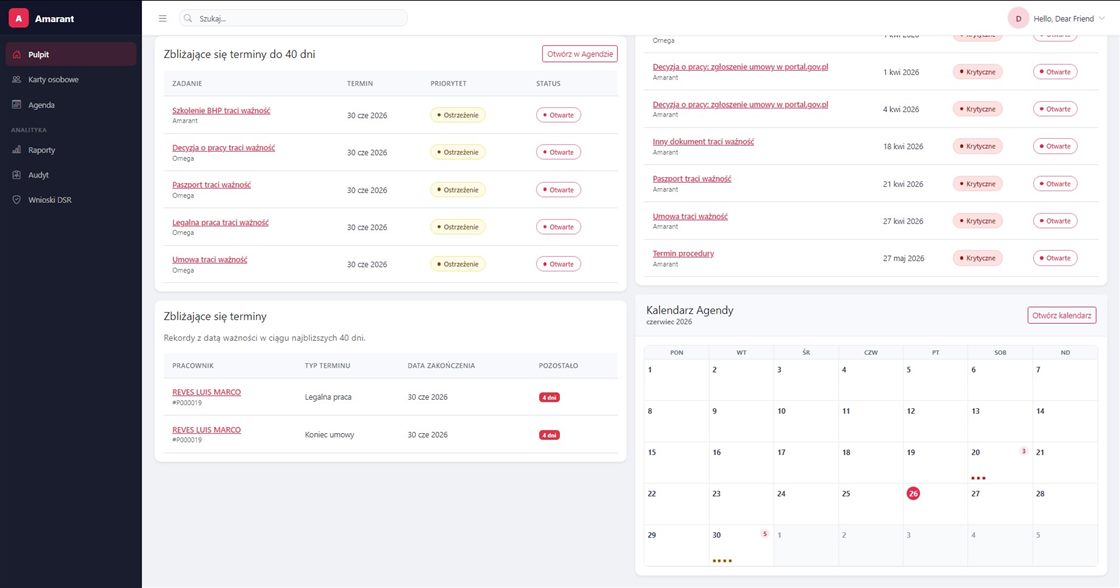
Amarant connects employee information, documents, deadlines, and team responsibility in one place.
The system is developed with changes relevant to foreign worker legalization workflows in mind.
The team can work in a browser on a computer, tablet, or phone.
The interface is available in Polish, English, and Ukrainian.
Administrators manage users, work scope, and access to information.
Key data, documents, deadlines, and case history are available in one view.
Files are linked to the right person and case, with quick access for authorized users.
An agency can support different client companies without mixing their data or responsibilities.
Roles limit access to information, while history helps identify who performed a key action.
The catalogue of rules and document types grows together with the system.
The biggest risk is not the document itself. It appears when the deadline, company context, and next task are scattered across different tools.
Files sit in folders, deadlines live in spreadsheets, and decisions are buried in messages. It is hard to quickly check who owns the case and what needs to happen next.
The employee card, documents, residence and work deadlines, tasks, comments, and change history are connected in one place. The team sees case status and next actions without searching through many tools.
Documents, deadlines, procedures, Agenda tasks, and reports work in one system so the team can see every case stage without manually watching many tools.
Access to data, tasks, and reports is controlled by context and role. The system separates agency scope, company scope, module scope, and specific permissions.
Amarant organizes daily work whether you support multiple client companies or your own workforce.
Separate client-company contexts with shared control of documents, deadlines, tasks, and reports.
One place for employee cards, documents, and actions related to the legalization process.
Structured procedures, team responsibility, and a change history attached to every case.
The system is designed with RODO/GDPR principles in mind. Roles and company context limit data access, while action history, retention, exports, and request handling support organized work with personal data.
Personal data, documents, and deadlines are managed in an organized way, with room for retention, data export, and data subject request handling.
The system records important case operations: status changes, comments, exports, logins, and user actions together with execution time.
Permissions can be split by role, company, and module, so users work only with the data they need for their task.
One plan with every feature. The price depends only on the number of users.
According to the Privacy Policy, personal data processed by the Controller are not transferred outside the European Economic Area (EEA) or to international organizations. We do not state that data are stored exclusively in Poland.
No. Amarant is a system for managing the legalization process: employee cards, documents, residence and work deadlines, procedures, Agenda tasks, and reports. It can work alongside an HR and payroll system as a separate environment for legalization control.
Complete the short access form. We will contact you, learn about your team, and present access terms tailored to the number of operators and the scale of workers you support.
Amarant has one plan with all features. The monthly price is PLN 400 net for 1 user, PLN 800 net for 2 users, and a maximum of PLN 1 200 net for 3 or more users. VAT is added to these prices.
The system separates access by role and company context, records important actions, and provides mechanisms for retention, data export, and data-subject request handling. Organizational details are agreed as part of the access terms.
Yes. You can gradually organize spreadsheet data and move it into employee cards. After that, documents, deadlines, tasks, and action history are managed in Amarant instead of scattered files.
Rules are configurable scenarios that the system checks automatically, for example when a work permit deadline is approaching. They can be defined by document type, company, or globally.
Complete the short form. We will contact you, learn about your team, and present the access terms for Amarant.